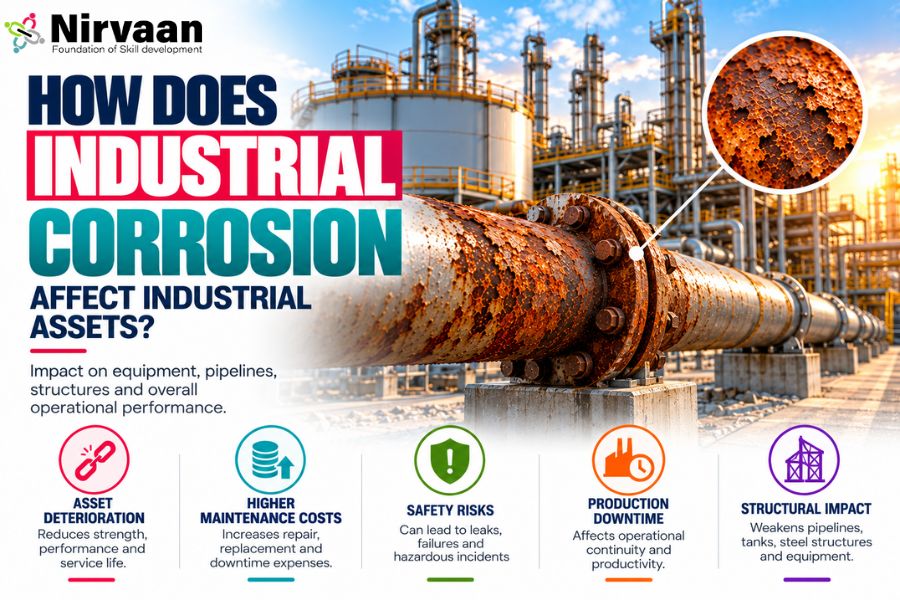
How Does Industrial Corrosion Affect Industrial Assets?
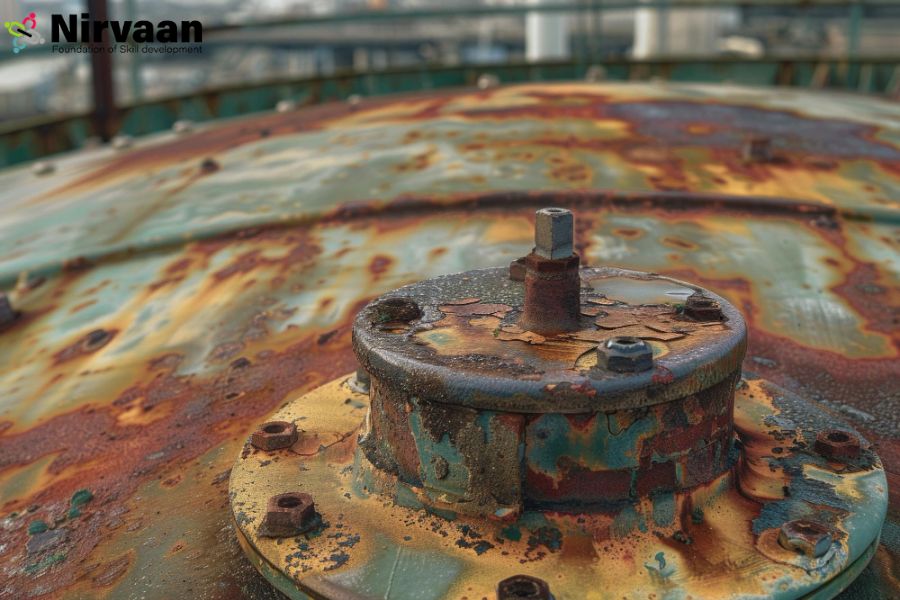
Corrosion is one of the major challenges faced by industries that rely on metallic equipment, structures, pipelines, storage tanks, machinery, and infrastructure. Although corrosion may begin as a small or localised deterioration, it can progressively affect the performance, reliability, and service life of an industrial asset.
Industries such as oil and gas, petrochemicals, power generation, marine, manufacturing, water treatment, and infrastructure can face significant corrosion-related challenges. Understanding how corrosion affects industrial assets is essential for developing effective inspection, maintenance, and corrosion-control strategies.
How Does Corrosion Begin on Industrial Assets?
Corrosion occurs when a material, particularly a metal, reacts with its surrounding environment. Moisture, oxygen, chemicals, salts, pollutants, temperature variations, and process fluids can contribute to corrosion.
Industrial assets often operate in demanding environments where exposure to these factors is difficult to avoid. For example, pipelines may come into contact with soil or water, offshore structures are continuously exposed to seawater and atmospheric conditions, while processing equipment may encounter corrosive chemicals.
Without suitable protection and monitoring, these conditions can gradually deteriorate metal surfaces and reduce material thickness.
Which Industrial Assets Are Most Vulnerable to Corrosion?
Almost any metallic industrial asset can experience corrosion when environmental and operating conditions are suitable.
Pipelines: Internal and external corrosion can reduce wall thickness and potentially compromise pipeline integrity.
Storage tanks: Tank floors, walls, roofs, and connections can be exposed to moisture, chemicals, and other corrosive conditions.
Steel structures: Industrial platforms, supports, bridges and structural components can be subject to degradation when protective systems fail.
Offshore structures: Marine environments contain saltwater, humidity and constant exposure to the elements which can accelerate corrosion.
Processing equipment: Chemical and petrochemical equipment may be exposed to aggressive fluids, gases, elevated temperatures, and pressure conditions.
The risks vary according to the material, design, operating environment, and corrosion mechanism.
How Does Corrosion Affect Asset Performance?
The most important result of corrosion is the slow removal of material. Metal deterioration can compromise the thickness and structural integrity of an asset.
For example, corrosion in a pipeline wall can decrease its ability to withstand operating pressure. Similarly, corrosion in a structural component may affect its load carrying capacity.
Corrosion can also impact the reliability and efficiency of equipment. Damaged components may need more often repairs or replacement and maintenance. In severe instances corrosion can result in degradation and unforeseen equipment failure.
This is why corrosion inspection and monitoring are important parts of industrial asset management.
Can Corrosion Increase Maintenance Costs?
Yes. Corrosion can create both direct and indirect costs for an organisation.
Direct costs may include inspection, cleaning, repair, coating replacement, component replacement, and corrosion-control systems. Indirect costs can arise from production interruptions, equipment downtime, delays, and operational disruptions.
If corrosion is identified early, organisations may have more opportunities to plan maintenance and address deterioration before it becomes severe. Delayed detection, on the other hand, can allow relatively manageable problems to develop into more extensive repairs.
A structured corrosion management approach can therefore support better maintenance planning and asset reliability.
How Can Corrosion Affect Industrial Safety?
Corrosion is not only a maintenance concern. Severe deterioration can become a safety issue when it affects critical components.
For example, corrosion-related weakening of pipelines, pressure-containing equipment, storage tanks, or structural members can create risks if the deterioration is not identified and managed appropriately.
Regular inspections help identify changes in asset condition. Depending on the asset and environment, organisations may use visual inspection, thickness measurements, coating inspection, cathodic protection monitoring, non-destructive testing, and other assessment techniques.
The objective is to understand the condition of an asset and determine appropriate preventive or corrective action.
What Role Does Protective Coating Play?
Often metal surfaces are coated to minimise their contact with corrosive environments. The coating, if correctly chosen and applied, can be a protective layer between the substrate and the environmental effects.
However, coating performance is dependent on a number of factors such as surface preparation, coating selection, application conditions, thickness, curing and inspection.
Defects such as cracking, blistering, peeling, pinholes, or inadequate adhesion can compromise protection. This makes coating inspection an important part of corrosion prevention.
Trained coating inspectors can help identify defects and verify whether coating systems meet specified requirements.
How Does Cathodic Protection Help?
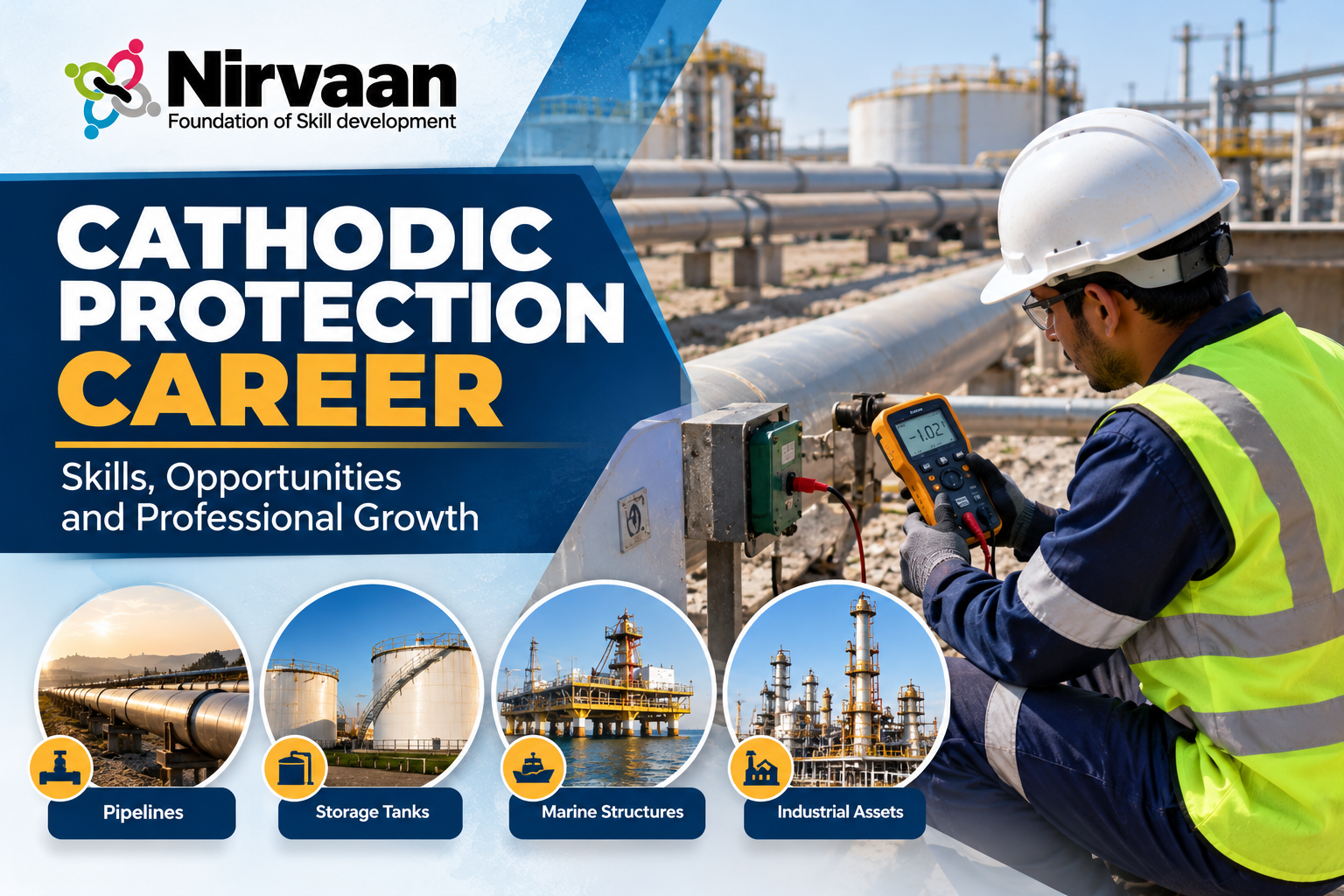
Cathodic protection is another important method used to control corrosion on suitable metallic structures. It is commonly applied to assets such as pipelines, storage tanks, offshore structures, and marine equipment.
Two widely used approaches are impressed current cathodic protection and sacrificial anode cathodic protection.
The effectiveness of a cathodic protection system depends on appropriate design, installation, monitoring, testing, and maintenance. Skilled professionals play an important role in ensuring that cathodic protection systems are properly assessed and managed.
Why Is Corrosion Training Important for Industries?
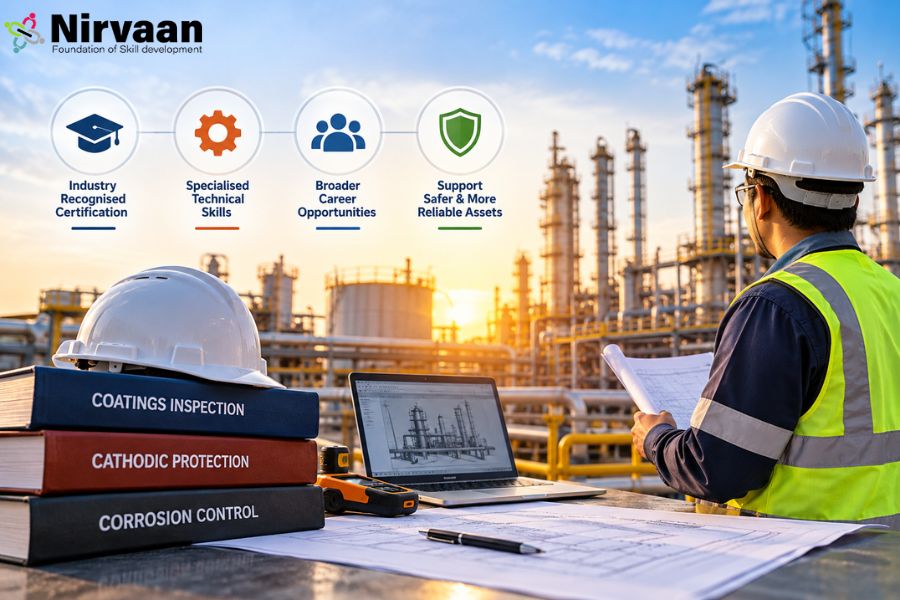
Technology and corrosion-control systems are only effective when people have the knowledge to use and manage them correctly. Engineers, inspectors, maintenance teams, and other industrial professionals can benefit from specialized corrosion training.
Training can help professionals understand corrosion mechanisms, inspection practices, protective coatings, cathodic protection, assessment methods, and industry standards.
For organisations, investing in technical skill development can also support a stronger corrosion-management culture and improve the ability of teams to identify potential problems early.
Frequently Asked Questions
What is industrial corrosion?
Industrial corrosion is the deterioration of materials, particularly metals, within industrial environments due to chemical or electrochemical interactions with their surroundings.
Which industrial assets are most affected by corrosion?
Pipelines, storage tanks, steel structures, offshore facilities, processing equipment, marine assets and other metallic infrastructure can be affected by corrosion.
Can industrial corrosion cause equipment failure?
Yes. Progressive material loss, pitting, cracking and other forms of deterioration can weaken components and potentially contribute to equipment failure if not properly managed.
Closing Insights – Nirvaan’s Perspective on Industrial Corrosion
At Nirvaan Foundation of Skill Development, we recognise that effective industrial corrosion control begins with awareness, knowledge, and practical skills. Protecting industrial assets requires more than responding to visible damage; it requires trained professionals who understand prevention, inspection, assessment, and control.
Nirvaan seeks to develop a more skilled workforce, ready to take on corrosion challenges through industry-focused training, hands-on learning, workshops and AMPP-certified courses on topics such as cathodic protection and coating inspection. In India, Nirvaan is helping to make industrial assets safer, more reliable and more sustainable through enhanced technical capability and corrosion awareness.
Image Reference: Magnific
Disclaimer: All trademarks, logos, and brand names are the property of their respective owners. All company, product, and service names used in this website are for identification purposes only. Use of these names, trademarks, and brands does not imply endorsement.